

What happens when art steps outside the white cube? For Yayoi Kusama, public space became a canvas as vital as her Infinity Mirror Rooms, from the mirrored spheres of Narcissus Garden to the polka-dot Pumpkin on Naoshima and Infinite Accumulation at London’s Liverpool Street. Maddox Gallery explores how 7 of her public art installations turned art in public space into a shared encounter for millions, and how the same pumpkins and polka dots live on in works collectors can own today.
Since August 2024, commuters passing through London's Liverpool Street station have had a gleaming piece of public art to distract them from the bustle of rush hour. Outside the entrance to the Elizabeth line, silver spheres rise from the pavement, twisting and looping in the air, their polished surfaces reflecting the surrounding buildings and the people streaming past. Titled Infinite Accumulation, it is the largest of Yayoi Kusama's public art installations, with its mirrored surfaces capturing a constantly changing picture of London life. Step beneath the sculpture and you'll find yourself reflected in it, too.
Long before public art became a magnet for social media attention, Kusama was taking her work out into the wider world. Why confine art to four walls when its surroundings could become part of the experience too? Following her death in August 2026, aged 97, we revisit seven of the most ambitious Yayoi Kusama public art installations, tracing a lesser-explored side of an artistic career spanning more than seven decades.
Art in Public Space: Why Public Art Matters More Than Ever
Public art encompasses sculptures, installations, murals and other artworks created for or presented in spaces accessible to the public. Unlike art displayed in a gallery, public art becomes part of the surrounding environment, whether permanently or temporarily. It can transform familiar spaces, encourage interaction and introduce artistic experiences to people who might never visit a museum or gallery.

Angel of the North in Gateshead. Designed by Antony Gormley, the 20m-tall steel sculpture is one of the North's most iconic images.
A work of art in public space has the power to change how we view our surroundings. A sculpture passed on the daily commute can become a local landmark, while a temporary installation has the potential to draw thousands of people to a location they would otherwise have little reason to visit. Some works become so closely associated with their surroundings that it is difficult to imagine one without the other. Think of Antony Gormley’s Angel of the North – an iconic sculpture and symbol of the North East since its installation in Gateshead, England, in 1998.
In June 2026, French artist JR showed just how many people a temporary public art installation can reach with La Caverne du Pont Neuf, his ambitious installation on Paris’ famous bridge. Free to visit and open around the clock, the work reimagined the historic bridge as a rocky cavern, paying tribute to the pioneering environmental artists Christo and Jeanne-Claude, who wrapped the same bridge in fabric in 1985. Over its 13-day run, 535,000 people ventured inside the installation – an average of more than 41,000 a day.
Social media has boosted the impact of public art in ways earlier generations of artists could never have imagined. It has also fundamentally changed how we encounter art in public space. Sculptures, murals and immersive installations now provide irresistible backdrops for Instagram photographs and TikTok videos, their images travelling around the world in a matter of hours. A striking sculpture or mural, shared far and wide, can put a city on the cultural map, attracting visitors keen to see it for themselves. And while an image on a screen can never quite capture the experience of standing before a public artwork, it can persuade someone to seek it out in person. When Banksy unveiled a series of animal-themed murals across London in August 2024, each new appearance sparked a flurry of social media attention, with people immediately heading to the locations to see the works for themselves.
Beyond the Gallery Walls: Why Yayoi Kusama Took Her Art Outside the White Cube

Yayoi Kusama, Harry Shunk, János Kender, The Anatomic Explosion, New York, 1968. Photograph: Shunk-Kender © Yayoi Kusama and J. Paul Getty Trust. The Getty Research Institute, Los Angeles
Kusama’s decision to take her art into public spaces can be traced back to New York in the 1960s, when she began staging performances in parks and on city streets. Already experimenting with painting, sculpture and immersive environments, she found new possibilities beyond the white cube of the traditional gallery, where anyone passing by could become part of the event.
Kusama’s provocative Body Festivals invited participants to have their bodies painted with polka dots, turning the human body into a living expression of her art. Her later Anatomic Explosions brought these performances onto the streets, where they became highly visible anti-war protests. In July 1968, she took her Anatomic Explosions to the Statue of Liberty, directing four naked, polka-dotted performers as they danced at the foot of the monument in a demonstration against the Vietnam War. These were audacious acts of public defiance, deliberately pushing the boundaries of what was considered acceptable, in art and society.
|
COLLECTOR INSIGHT: OUTSIDE THE WHITE CUBE – WHERE THE PHRASE COMES FROM The term “white cube” was popularised by Irish art critic Brian O’Doherty in his influential 1976 essay Inside the White Cube. O’Doherty questioned the supposed neutrality of the white-walled gallery, arguing that its carefully controlled environment influences how art is experienced. |

Yayoi Kusama, Infinity Mirrored Room – The Souls of Millions of Light Years Away, 2013. Courtesy of David Zwirner, N.Y. © Yayoi Kusama
Behind Kusama’s performances lay ideas that had occupied her since childhood. Fascinated by infinity and the possibility of losing oneself within it, she developed the concept of “self-obliteration”, using repeated patterns to dissolve the boundaries between the individual and the surrounding world. Her Infinity Net paintings covered canvases with thousands of tiny, repeated marks, while her Infinity Mirror Rooms multiplied reflections until the viewer appeared to disappear into an endless expanse. Even the polka dots painted on the bodies of her performers were part of this exploration, incorporating individual figures into a larger pattern.
The audience was an essential part of her performances. Instead of simply observing her work, people found themselves caught up in it, whether as willing participants or as unsuspecting passers-by. By involving the public in this way, Kusama blurred the boundaries between artist, artwork and audience, giving her ideas about self-obliteration a new, very public dimension.
For more on her life, artistic influences and career, explore our Guide to Yayoi Kusama Art.
7 Yayoi Kusama Public Art Installations That Turned the World into Her Canvas
Kusama’s public art evolved considerably over the years, from unauthorised interventions at established art events to large-scale Yayoi Kusama sculptures commissioned for some of the world’s busiest public spaces. Our selection takes us from Venice in 1966 to London in 2024.
1. Narcissus Garden (1966): Kusama’s Mirrored Spheres Crash the Venice Biennale
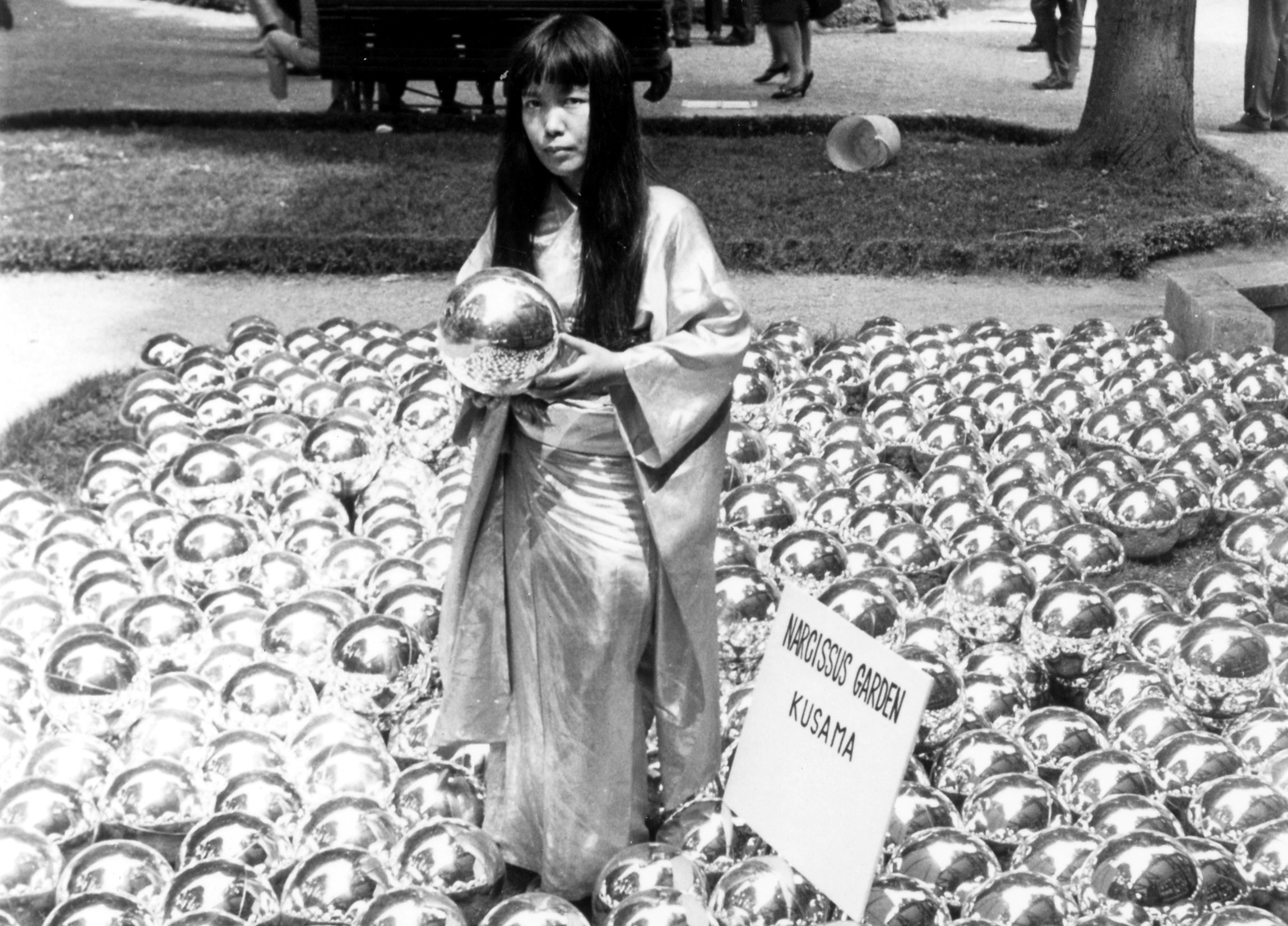
Yayoi Kusama with Narcissus Garden, 1966, installed in Venice Biennale, Italy, 1966 © YAYOI KUSAMA. Courtesy David Zwirner, New York; Ota Fine Arts, Tokyo/Singapore/Shanghai; Victoria Miro, London/Venice.
Kusama caused a sensation at the 1966 Venice Biennale with Narcissus Garden, an installation of 1,500 silver spheres arranged across the lawn outside the Italian Pavilion. Although not officially invited to exhibit, she had secured permission for the installation, which turned the grass into a shimmering field of reflections. The work built on her first Infinity Mirror Room, created in New York the previous year, but instead of enclosing visitors in a mirrored space, Kusama used the spheres to capture and multiply reflections of the people and landscape around them.
Named after the mythological Narcissus, who fell in love with his own reflection, the installation explored our fascination with our own image while also questioning the commercialisation of art. Kusama took her critique a step further when she began selling the spheres for $2 each, dressed in a gold kimono and standing beneath a sign reading “YOUR NARCISSISM FOR SALE”. Biennale officials soon put a stop to the sales, although the spheres were allowed to stay on display. The work has since been recreated in locations around the world.
2. The Naoshima Pumpkin (1994): The Kusama Pumpkin Sculpture That Became an Icon
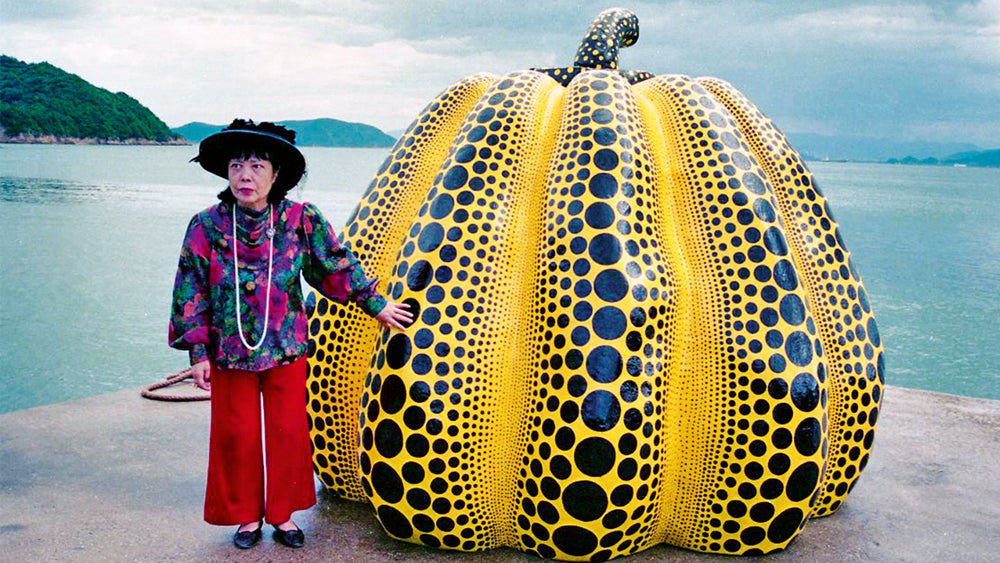
Yayoi Kusama Pumpkin sculpture © YAYOI KUSAMA. Image courtesy of Benesse Art Site Naoshima. Photo: Shigeo Anzai.
Perched on an old pier overlooking Japan’s Seto Inland Sea, the yellow-and-black Yayoi Kusama Pumpkin sculpture has become one of the most photographed sights on an island celebrated for its Contemporary art. Created for the 1994 exhibition ‘Open Air ’94: Out of Bounds’, it marked a milestone for Yayoi Kusama sculptures as the first designed specifically for outdoor display, with its bright colour chosen to stand out against the blue sea and green coastline.
Kusama saw something in the humble pumpkin that others might overlook: its peculiar shape and almost comical appearance. In Pumpkin (1994), the familiar vegetable became a sculpture standing at two metres tall, covered in the polka dots that were her artistic signature. In August 2021, a typhoon swept the pumpkin off the pier and into the sea, badly damaging the sculpture. Following its restoration, it returned to its original position in October 2022, much to the delight of visitors.
DISCOVER KUSAMA’S PUMPKIN SERIES
3. Ascension of Polka Dots on the Trees (2002): When a Whole Street Wears Polka Dots

Yayoi Kusama Ascension of polka dots on the trees, Christophe Sevault © Yayoi Kusama
In 2002, the artist took her polka dots onto the streets with Ascension of Polka Dots on the Trees, first presented at Japan’s Kirishima Open-Air Museum. Along the museum’s outdoor pathways, tree trunks were wrapped in red fabric patterned with white polka dots, contrasting with the surrounding greenery and turning a woodland walk into an encounter with a Yayoi Kusama installation. In her vision, the trees were no longer separate forms but part of a vast, interconnected pattern, echoing her fascination with self-obliteration.
The installation subsequently appeared in other cities, including Singapore for the 2006 Biennale and London in 2009, when 25 trees near the Hayward Gallery on the South Bank received the polka-dot treatment. In Melbourne in 2024, more than 60 trees on St Kilda Road were wrapped in pink and white ahead of Kusama’s exhibition at the National Gallery of Victoria, making her art part of the everyday experience of pedestrians and passing traffic.
4. Shine of Life (2019): Kusama Rises from the Water at Kistefos
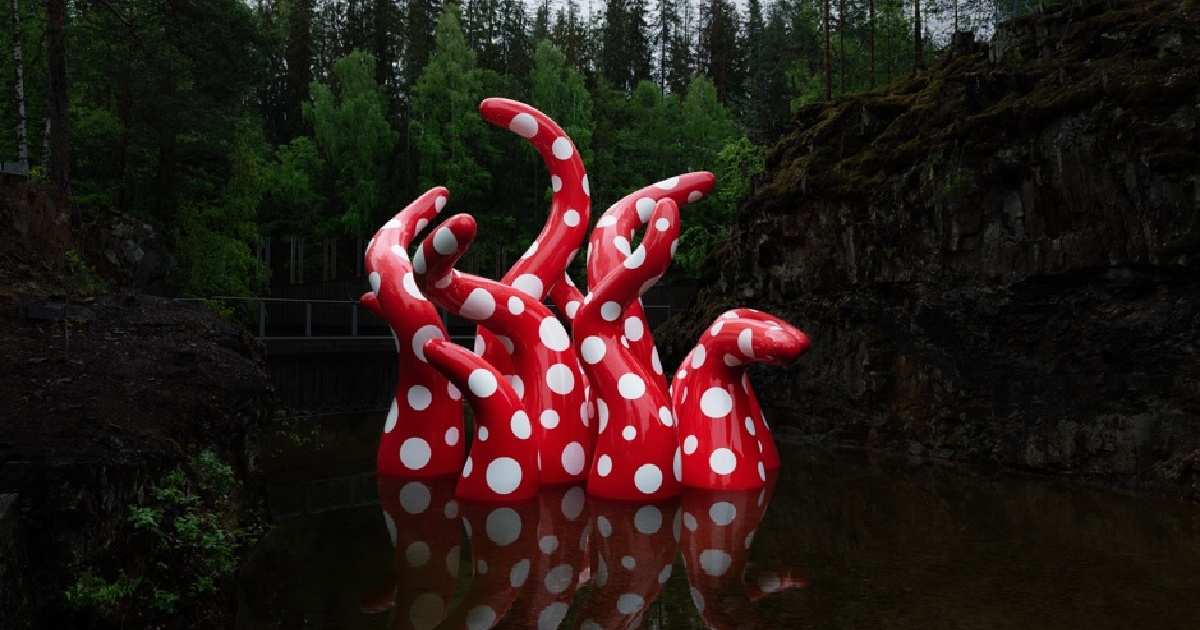 Yayoi Kusama, Shine of Life, 2019, Kistefos © YAYOI KUSAMA, Courtesy Ota Fine Arts, Tokyo/Singapore/Shanghai and Victoria Miro, London/Venice. © YAYOI KUSAMA, Photo: Einar Aslaksen
At Kistefos sculpture park in Norway, Kusama’s Shine of Life (2019) appears to grow directly out of the water. Rising six metres above the surface of a former mill inlet, the aluminium sculpture has tentacle-like forms covered in brightly coloured polka dots, which stand out all the more against the muted tones of the industrial building behind it. An expression of Kusama's fascination with infinite accumulation, achieved without a single mirror, it is her largest sculpture in the Nordic countries and was developed specifically for the site.
The work carried a message of hope for Kusama. “My eternal soul is now rising up to the universe,” she declared, expressing her wish for a world filled with love and peace. Seen from different points around the water, its vibrant forms seem to rise, curl and multiply, with the reflections creating the illusion that the sculpture extends beneath the surface.
5. A Message of Love, Directly from My Heart unto the Universe (2022): Kusama Underground at Grand Central Madison
Yayoi Kusama, A Message of Love, Directly from My Heart unto the Universe, 2022. Photo by Kerry McFate © YAYOI KUSAMA Courtesy of Ota Fine Arts, David Zwirner
Having first made her name in New York during the 1960s, Kusama returned to the city some 60 years later with a public artwork intended to spread love, peace and joy among passing commuters. For her 2022 commission at the Grand Central Madison railway terminal, Kusama turned to a very different medium – mosaic – translating the exuberant imagery of her My Eternal Soul paintings into a vast mural of coloured glass. Stretching more than 36 metres along the concourse, it is crowded with smiling faces, radiant suns, swirling shapes and polka dots in brilliant reds, blues, oranges and yellows.
Fabricated by Miotto Mosaics Art Studios, the glass pieces were shaped and cut by specialist artisans in Murano, Italy. Up close, the miniature tiles reveal the painstaking work behind the composition, while the density of faces, symbols and patterns means there is always something new to discover, even for those who walk past it every day.
Kusama’s mosaic is part of a wider public art programme created for the new Grand Central Madison terminal, which opened in January 2023. Its title is a message in itself, echoed in the words Kusama wrote to accompany the commission: “My wish is to deliver this vision, with all that is my life, to the people of New York.”
ENQUIRE ABOUT KUSAMA’S PUMPKIN SERIES
6. Pumpkin (2024): Kusama’s Bronze Giant in Kensington Gardens
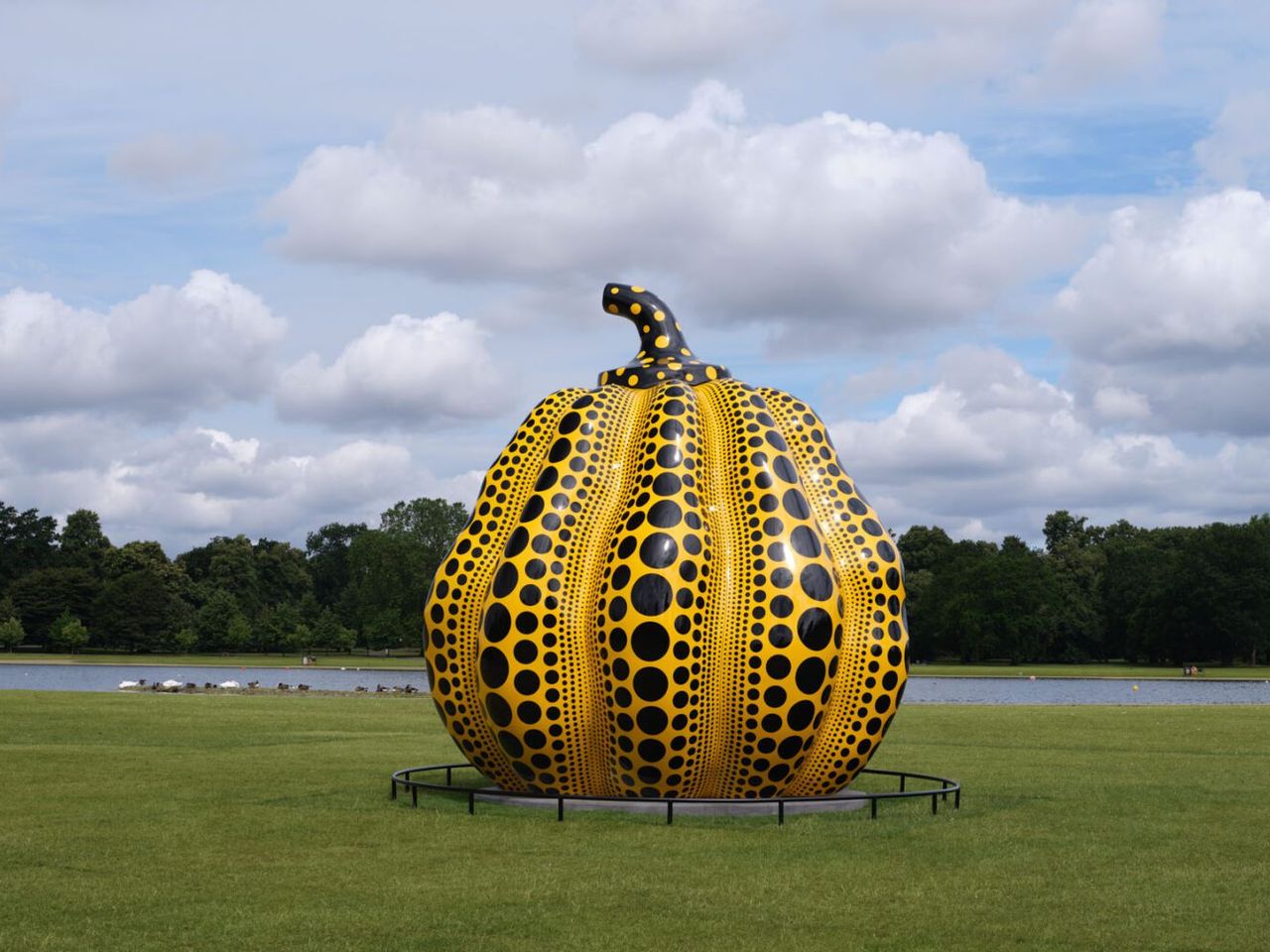
Pumpkin, which stands at 19.5 feet tall, is Kusama's tallest bronze gourd sculpture to date. © Yayoi Kusama / Ota Fine Arts / Victoria Miro / David Zwirner
In 2024, Londoners had just four months to enjoy an enormous new Kusama Pumpkin sculpture, which occupied a grassy spot beside the Round Pond in Kensington Gardens from July to November. Standing six metres tall and 5.5 metres wide, it is her tallest bronze pumpkin sculpture, its brilliant yellow surface covered in black polka dots. Surrounded by trees and open parkland, it was a wonderfully eccentric addition to the landscape, particularly for unsuspecting joggers and dog walkers.
The Kusama Kensington Gardens pumpkin sculpture also marked the artist’s return to the Serpentine, which had hosted her first British retrospective in 2000. Pumpkins held a deeply personal significance for the artist, whose family grew their seeds during her childhood in Japan. Kusama often regarded them as a form of self-portrait, admiring their humble appearance and reassuring shapes. “I am sending to London with love my giant pumpkin,” she declared, describing the vegetable as a source of comfort and joy throughout her life.
7. Infinite Accumulation (2024): Kusama’s Largest Public Sculpture, at Liverpool Street
Yayoi Kusama, Infinite Accumulation, 2024 Liverpool Street station (Elizabeth line). Commissioned as part of The Crossrail Art Programme, 2017 © YAYOI KUSAMA. Courtesy Ota Fine Arts and Victoria Miro. Photo: Thierry Bal
Stretching approximately 100 metres across the pedestrian plaza of Liverpool Street Station in London, Infinite Accumulation was unveiled in August 2024. It was Kusama’s second major public artwork to appear in London that summer, following the installation of her yellow Pumpkin in Kensington Gardens just a month earlier.
Inspired by Kusama’s famous polka dots, the silver spheres represent the different personalities that make up a city, while the curving lines connecting them suggest the social structures that bind people together. Kusama’s first permanent public sculpture in the UK, it was the final commission in the Crossrail Art Programme, co-funded by British Land and the City of London Corporation.
The towering public artwork brought together ideas Kusama had been exploring for a lifetime. The polished spheres recall those of Narcissus Garden, her controversial installation at the 1966 Venice Biennale, while their arrangement in interconnected curves takes her fascination with pattern and repetition in a new direction. Where the Venice installation scattered mirrored spheres across the grass, Infinite Accumulation lifts them into the air, creating a permanent sculptural structure that people can walk beneath.
DISCOVER OTHER BLUE-CHIP ARTISTS AT MADDOX
Pumpkins, Polka Dots and Mirrors: Why Kusama’s Public Art Is Instantly Recognisable

A portrait of the late artist, Yayoi Kusama © Gamma-Rapho via Getty Images
You don't need to see Kusama’s name beside an artwork to recognise it. So what is Yayoi Kusama known for, exactly? Her pumpkins have become as familiar as her polka dots, while her mirrored installations have introduced millions of visitors to the peculiar sensation of seeing themselves repeated into infinity. She returned to these motifs again and again throughout her career, using them in paintings, sculptures and installations, even as her work grew in scale and moved between different mediums.
These familiar motifs take on very different qualities depending on how and where they are encountered. Kusama’s pumpkins might appear in paintings or as sculptures that visitors can walk around, while her mirrored installations make the viewer’s own reflection part of the artwork. Her polka dots have travelled even further, appearing on everything from human bodies to trees and entire buildings.
Kusama’s collaborations with Louis Vuitton helped cement her status as a global art superstar with an instantly recognisable artistic style. First joining forces in 2012, the artist and fashion house reunited in 2023 for a high-profile campaign, with her polka dots and pumpkins appearing everywhere from handbags to enormous 3D billboards in Tokyo and New York. Read more in our feature on seven trailblazing art and fashion collaborations.
Where Yayoi Kusama’s Art Lives On: Her Public Art Legacy
Since her death this summer, audiences around the world continue to seek out Kusama’s creations. For those wondering where to see Yayoi Kusama art, her legacy extends from Japan to New York and London, where her monumental sculptures and installations have become destinations in their own right. While some were temporary spectacles, others are permanent fixtures.
|
COLLECTOR INSIGHT: WHERE TO SEE KUSAMA’S PUBLIC ART TODAY Yayoi Kusama public art can be found across the globe. Japan is home to her famous yellow and red pumpkins on Naoshima island, alongside giant flower sculptures in Niigata and Matsumoto. Further afield, other permanent works can be found at Norway’s Kistefos sculpture park, London’s Liverpool Street Station and even among the koi ponds of a Honolulu shopping centre. |
In the wake of her recent passing, institutions are also celebrating the extraordinary breadth of Kusama's artistic achievements. A major Yayoi Kusama exhibit at the Stedelijk Museum in Amsterdam runs until 17 January 2027, bringing together more than 300 works. Tokyo's Yayoi Kusama Museum is exploring the artist's lifelong fascination with light in The Light Spreads Out, and Glittering Things Start Appearing All Around Me, on view until 31 January 2027. And in Boston, the Institute of Contemporary Art is bringing back LOVE IS CALLING, one of her largest Infinity Mirror Rooms, from 15 October 2026.
The latest Yayoi Kusama exhibitions follow the success of recent retrospectives, including the National Gallery of Victoria's landmark 2024-25 exhibition in Melbourne. Read our coverage of the NGV's Yayoi Kusama exhibition.
Kusama once wrote of her determination to create art that would live on beyond her lifetime. From the shores of Naoshima to public spaces around the world, her work continues to be seen and enjoyed by millions.
From Public Space to Private Collection: Collecting Yayoi Kusama’s Pumpkins and Polka Dots

Yayoi Kusama, Dancing Pumpkin (YBL) (Kusama 320) (2004)
The pumpkins and polka dots that have made her public installations so iconic also appear in Kusama artwork, with her Pumpkin screenprints particularly sought after. Maddox Gallery offers a selection of Yayoi Kusama Pumpkin prints, including the yellow-and-black Pumpkin (T) from 2003 and Pumpkin (OG) from 1992.
When acquiring a Kusama print, edition size, condition, provenance and authentication are essential considerations. The date and colourway of a work can also influence its desirability, with signed and numbered editions particularly prized by collectors. Given the number of reproductions and Kusama-inspired products in circulation, establishing a work’s authenticity is especially important.
For further guidance, read our article, Why Every Collector Should Have a Kusama Print.
Explore Yayoi Kusama’s Art at Maddox Gallery
Discover Kusama’s celebrated prints, including works featuring her iconic pumpkins, in the Maddox Gallery collection.
Explore Yayoi Kusama artworks available at Maddox Gallery, or speak to one of our art advisors for guidance on adding her work to your collection.


