
September 24, 2025
Artistic collaborations spark magic when creative minds collide. Discover how 5 pairs of collaborative artists—from Warhol & Basquiat to Murakami & Virgil Abloh—co-created some of the most memorable masterpieces in recent art history. From street art pioneers to photography crossovers, explore the partnerships that redefined the art of collaboration.
The Magic of Art Collaboration: Why Artist Duos Create Extraordinary Art

Keith Haring, Andy Warhol and Jean-Michel Basquiat
From Renaissance workshops to the 21st century’s more experimental pairings, artistic collaborations have long fascinated the creative world. When two artists join forces, the result is rarely just a merging of styles. Rather, it’s a dialogue that sparks new visual languages, resulting in artworks neither could have achieved alone.
The art of collaboration lies in the friction and flow between two visions. Each artist brings distinct skills, instincts and references to the partnership. In conversation, they have the potential to unlock unexpected directions that add new dimensions to ideas of authorship, originality and cultural influence.
For collectors, artist duos hold particular intrigue. Their projects are often fleeting, leaving behind a finite body of work. These canvases, prints and murals frequently become cultural milestones—moments where two creative visions collided, leaving a lasting imprint on Pop Art, street art and beyond.
The Power of Two: 5 Famous Artist Collaborations That Transformed Contemporary Art
Whether born from friendship, mentorship or mutual curiosity, these five artistic collaborations demonstrate the power of partnership.
#1. Andy Warhol and Jean-Michel Basquiat: When Pop Art Meets Neo Expressionism
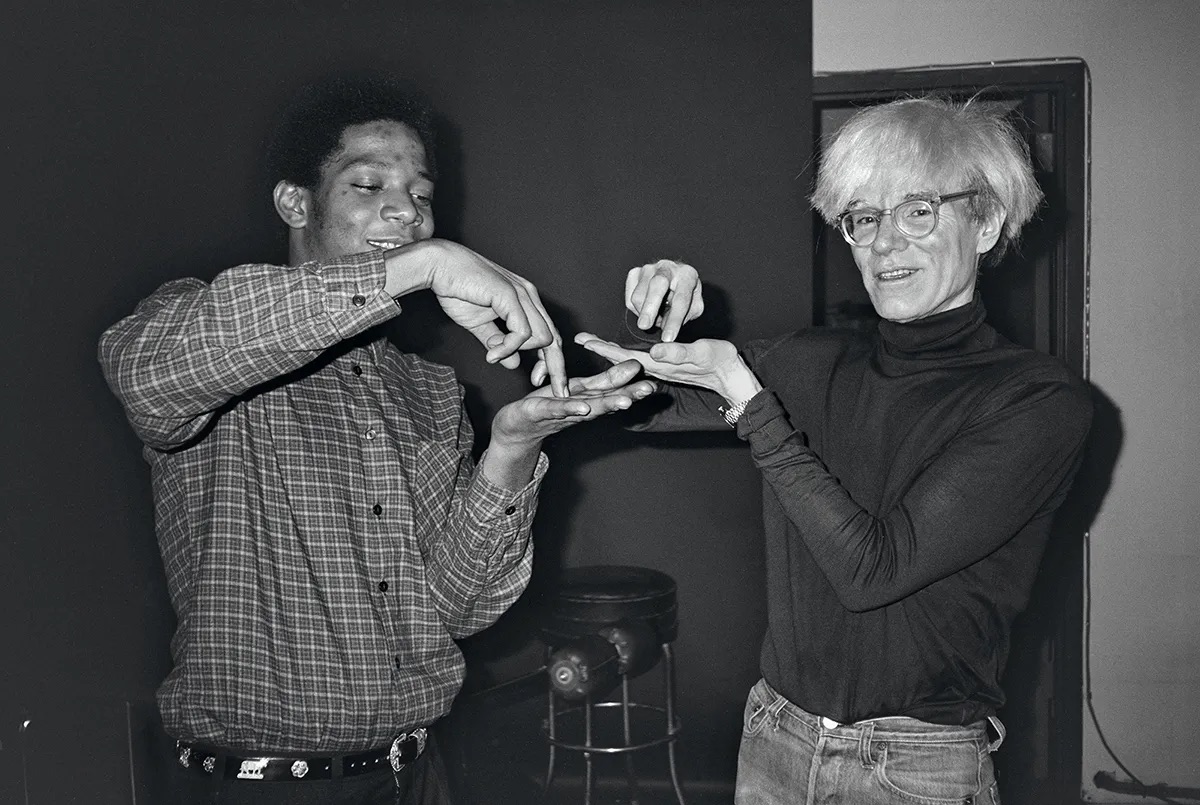
Jean Michel And Andy At 860 Broadway, October 26, 1983.© The Andy Warhol Foundation For The Visual Arts, Inc.
The collaboration between Andy Warhol and Jean-Michel Basquiat played out like theatre in 1980s New York, with more than 160 works emerging from their volatile blend of reverence and competition. Their first encounter in 1982 was almost cinematic: Basquiat, the rising downtown street artist, painted a double portrait of himself with Warhol immediately after their lunch meeting, delivering it still wet.
Their creative process became a visual exchange. Warhol laid down silkscreened logos and consumer goods; Basquiat attacked them with scrawled heads, symbols and visceral brushwork. The resulting Warhol Basquiat paintings fused Pop Art’s cool detachment with Neo-Expressionism’s urgency, creating a hybrid voice that neither could have found alone. Keith Haring, who witnessed the works develop, described them as “a physical conversation happening in paint instead of words”.
Not everyone was convinced. Their 1985 show in New York was savaged by critics, with one headline dismissing the exhibition as “Warhol by numbers and Basquiat on autopilot”. Yet time has rewritten that narrative. What once looked opportunistic is now recognised as one of the most significant creative exchanges of the 20th century.
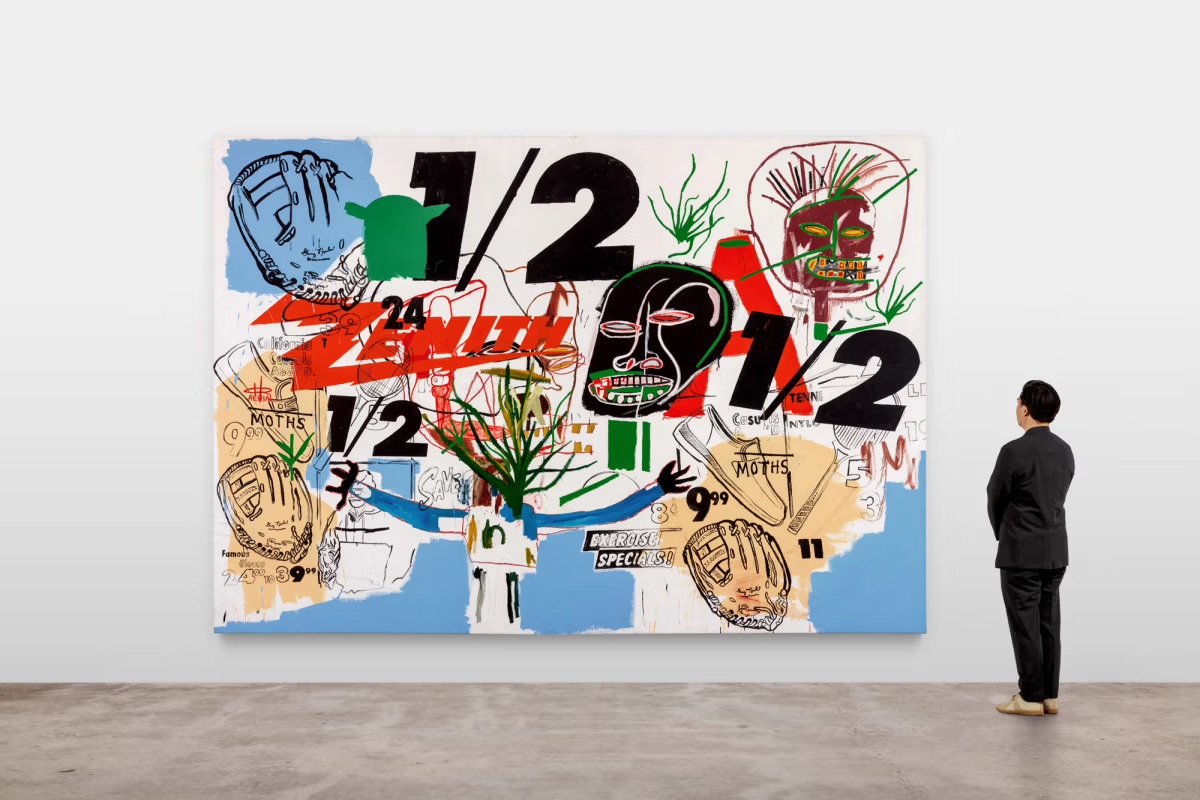
Untitled (1984) © Sotheby's
Recent exhibitions have reframed this legacy. ‘Basquiat x Warhol: Painting Four Hands’ at the Fondation Louis Vuitton in 2023, later shown at the Brant Foundation in New York, presented their artwork collaboration as a genuine meeting of minds rather than a power imbalance. Audiences responded with record attendance, confirming the duo’s collective magnetism. And in May 2024, Sotheby’s sold Untitled (1984) for $19.4 million—a record for their joint work. Measuring nearly 10 x 13 feet, the enormous canvas epitomises their partnership, with the first layer of imagery, including logos and sports equipment like sneakers and baseball mitts, added by Warhol, which Basquiat then "defaced" with his signature figures and scrawls.
Warhol and Basquiat partnership remains one of the most famous artist collaborations in history. It brought together an elder statesman of Pop and a prodigy of the streets, capturing a cultural moment when New York itself was in flux.
#2. Andy Warhol and Keith Haring: Icons of Accessible Art
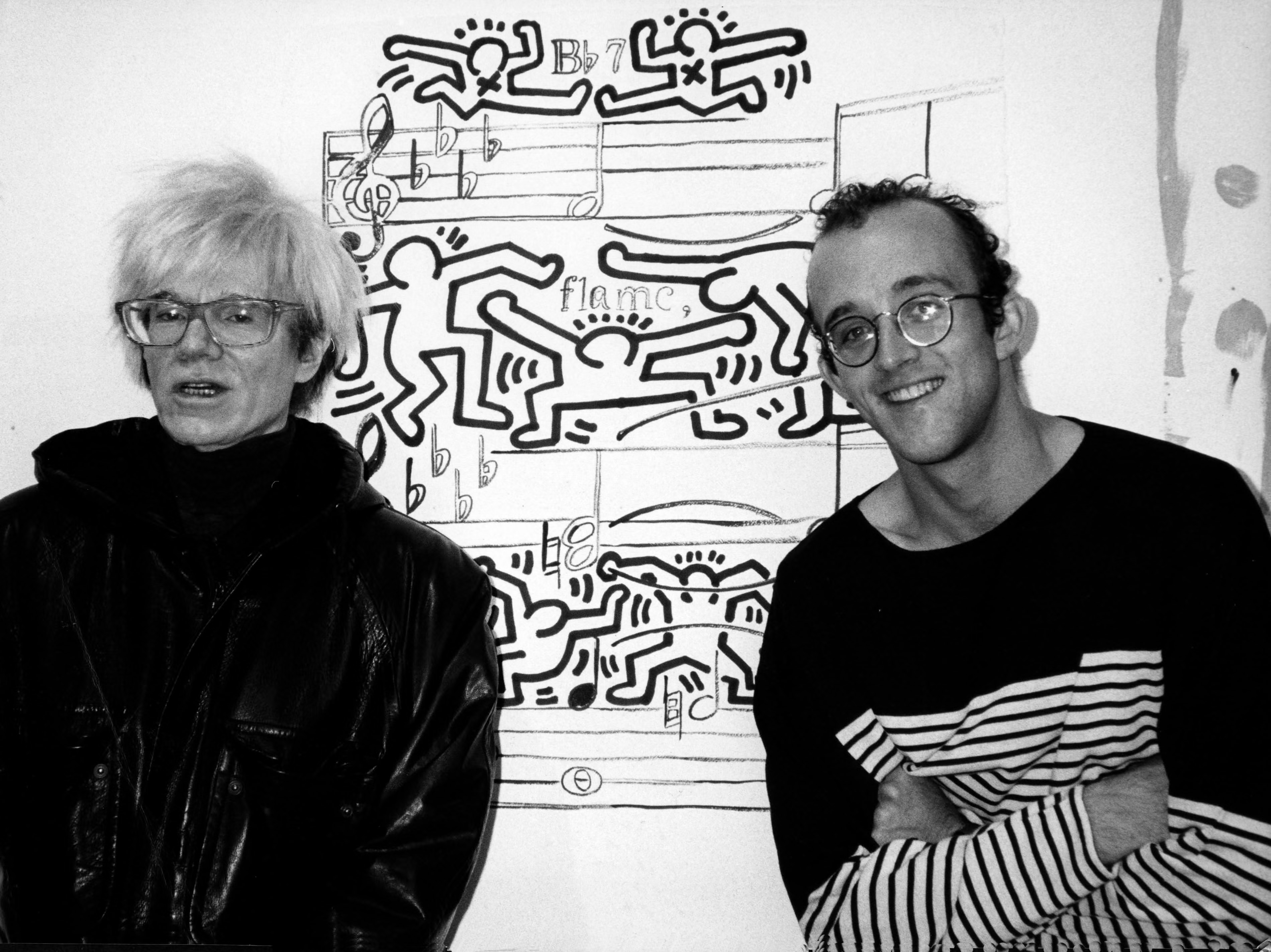
Andy Warhol and Keith Haring with their poster design for the 1986 Montreux jazz festival. © Keystone Press/Alamy Stock Photo
“Andy’s life and work made my work possible,” Keith Haring once confessed in his journal. That sense of mentorship framed the relationship between Andy Warhol and Keith Haring, which blossomed into one of Pop Art’s most democratic collaborations.
The two exchanged artworks and ideas freely. Warhol painted Haring and his partner Juan Dubose in his trademark palette, while Haring responded with the cheeky Andy Mouse series (1986), a mashup of Mickey Mouse and Warhol himself, commenting on art’s commodification.
The Andy Warhol Keith Haring collaboration extended beyond the studio, into activism and accessibility. Haring, who was deeply involved in raising awareness around the AIDS crisis, saw Warhol’s validation as a way to amplify his own mission of bringing art to the public. Warhol supported Haring’s Pop Shop, which sold affordable prints, t-shirts and badges emblazoned with his bold motifs, and even designed a range of merchandise for the store, lending his endorsement to Haring’s radical idea that art should live on the streets, not just in galleries.

Keith Haring, Pop Shop IV, 1989
In 2024, Munich’s Museum Brandhorst staged ‘Andy Warhol & Keith Haring: Party of Life’, the first major institutional exhibition dedicated to their partnership. With more than 100,000 visitors in its first four months, it demonstrated how powerfully their collaborative spirit still speaks to audiences today.
The market continues to reinforce their legacy of collaboration in art. In April 2025, one of Haring’s Andy Mouse prints achieved a record $325,000 at Heritage Auctions. Rather than mere Pop Art artefacts, these works symbolise a moment when art became accessible, joyful and unashamedly democratic.
|
3 Reasons Collectors Love Artist Collaborations
|
#3. Russell Young and Terry O'Neill: Photography Meets Fine Art

Russell Young, Mick Jagger Diptych (Love White), 2023
Brigitte Bardot with a cigar, David Bowie mid-performance, Mick Jagger caught in a pout—the late British photographer Terry O’Neill had a gift for immortalising cultural icons in moments that felt both spontaneous and defining. His images came to symbolise the glamour and spirit of the 1960s and beyond.
Decades later, British-American artist Russell Young revisited these photographs in his glittering ‘Dreamland’ series. Known for his large-scale silkscreens that probe the allure and excess of fame, Young layered pigment and diamond dust over O’Neill’s images, transforming documentary snapshots into monumental icons.
Where O’Neill captured fame in unguarded moments, Young reframed it through the lens of myth and critique. Bardot became a shimmering archetype; Bowie, a kaleidoscopic persona; Jagger, a study in charisma. What O’Neill froze in time, Young reignited, creating canvases that flicker between nostalgia and deconstruction.

Russell Young Solo Exhibition ‘Dreamland’, 2023
Though not a direct collaboration, the series created a bridge across generations, with O’Neill’s photography documenting celebrity in real time and Young’s art interrogating it as spectacle. When Maddox exhibited ‘Dreamland’ in London in 2023, the show drew widespread attention from collectors struck by the seductive yet unsettling edge that defines Young’s treatment of celebrity. In his hands, O’Neill’s images shift from documentary to myth, exposing both the seduction and the price of fame.
#4. The Stik Thierry Noir Collab: Street Art Legends Unite

Thierry Noir and STIK © Imperial War Museums
In 1980s Germany, the French artist and muralist Thierry Noir covered the Berlin Wall with cartoon faces, painted at breakneck speed under the threat of arrest. Two decades later in East London, Stik began painting minimalist stick figures on the city streets while experiencing homelessness, his art reflecting both the loneliness of his situation and the universal need for connection. Though separated by time and place, their street art carried the same vulnerability, humour, empathy and defiance, conveyed through a deceptively simple visual language.
The two artists met in 2012, when Stik visited Noir’s Berlin studio. Soon after, they created the large-scale mural In Conversation on the 128-square-metre Village Underground Wall in London’s Shoreditch. One of Noir’s iconic heads stood face to face with one of Stik’s stick figures, symbolising a meeting between two generations of street artists. They also appeared together for a public talk at the Courtauld Institute of Art, Somerset House, exploring street art’s origins and the inspirations behind their work. By speaking at such a prestigious institution, they showed how a practice that emerged from the margins was now firmly part of the mainstream.

Thierry Noir and STIK’s Wall © Imperial War Museums
In 2019, they reunited to create Wall, painted on original slabs of the Berlin Wall to mark the 30th anniversary of its fall. Installed outside London’s Imperial War Museum, the work depicted two figures confronting one another. “I hope our collaboration on the Berlin Wall will highlight the importance of connection between people through times of division and change,” Stik explained at the unveiling.
These Stik Thierry Noir projects demonstrate how collaborative artists can amplify messages of resistance through shared works of public art. Noir’s faces, once painted in defiance of Cold War division, meet Stik’s figures, which are rooted in personal struggle and a desire for solidarity. From In Conversation in Shoreditch to Wall at the Imperial War Museum, their works show how street art has evolved from urgent acts of survival to lasting markers of cultural memory.
#5. Takashi Murakami x Virgil Abloh: Contemporary Crossover

Virgil Abloh and Takashi Murakami. Photograph by Olivia Arthur/Magnum Photos
Few creative partnerships in recent memory captured the spirit of cultural cross-pollination quite like the Takashi Murakami x Virgil Abloh collaboration. Murakami, the father of Japan’s “Superflat” movement, is celebrated for fusing anime aesthetics with high art, while Abloh, the late founder of Off-White and Artistic Director at Louis Vuitton menswear, redefined the boundaries between streetwear, luxury and contemporary culture.
Their partnership began in 2018, when Abloh exhibited at Murakami’s Kaikai Kiki Gallery in Tokyo, and quickly evolved into an exchange that blurred the boundaries between art, design and fashion. The duo presented joint works at several high-profile exhibitions, where Murakami’s smiling flowers intertwined with Abloh’s quotation marks and graphic interventions. Together, they forged a new visual vocabulary that thrived as much in the gallery as in the cultural mainstream.
The impact of the Takashi Murakami Virgil Abloh collaboration extended far beyond art institutions. By merging Murakami’s pop-infused Japanese visual tradition with Abloh’s design ethos rooted in streetwear and architecture, they reached audiences far beyond the usual bounds of fine art. Their works embodied a globally connected vision of creativity, collapsing boundaries between “high” and “low” culture.
Following Abloh’s untimely passing in 2021, their collaboration artworks have taken on additional significance as a posthumous dialogue. Today, their joint works stand as markers of a transformative moment in collaborative Contemporary art and design, showing how collaboration can unite worlds, audiences and disciplines.
|
Art Market Insight: How Art Collaborations Shape the Art Market
|
The Enduring Appeal of Artistic Collaborations
Artistic collaborations are hardly new. Fashion houses have long partnered with artists—think Louis Vuitton and Yayoi Kusama, or Alexander McQueen and Damien Hirst. Brands and musicians, too, have embraced crossover projects, from Swatch x Keith Haring to album cover artwork created by George Condo and KAWS for Kanye West. Even philanthropy has become a collaborative canvas, with artists such as David Yarrow joining forces on charity-led initiatives.
Yet collaboration artists remain comparatively rare. When they do happen, they carry a unique intensity, as two visions collide to create something that speaks both to its moment and to art history.
Looking ahead, the possibilities of collaboration are widening. From AI-assisted installations to blockchain and immersive VR projects being commissioned by artists and institutions, creative partnerships are pushing the boundaries of medium and meaning. These experiments will continue to act as mirrors of cultural change, just as Warhol and Basquiat once reflected the spirit of 1980s New York and Murakami and Abloh captured the crosscurrents of fashion and art in the 2010s.
For collectors and art lovers alike, collaborative artists are living testament to the power of shared creativity and reminders that some of the most enduring artworks are born not in isolation, but in partnership.
To learn more about famous art collaborations and their lasting impact on the Contemporary art world, contact the Maddox Gallery Art Advisory team.
Frequently Asked Questions
Featured Artists


Previous
Next
READ MORE


Previous
Next
Basket
Please note items are not reserved until you have completed checkout.
No items found
Close
Your saved list
This list allows you to enquire about a group of works.
No items found
Enter your email to subscribe to our weekly newsletter.
Speak to a Maddox Art Advisor
Please enter your details below and someone from Maddox Gallery will call or email you back.
Mikael B
Register your interest in
Mikael B
Ross Muir
Register your interest in
Ross Muir
Andy Gotts
Register your interest in
Andy Gotts
Seb Chaumeton
Register your interest in
Seb Chaumeton
Miaz Brothers
Register your interest in
Miaz Brothers
The Connor Brothers
Register your interest in
The Connor Brothers
Jerkface
Register your interest in Jerkface.
Register your interest in

London
Gstaad
Los Angeles


