
March 12, 2026
Across the art market, value concentrates around an artist’s defining creative years. Few examples are clearer than the price of Basquiat paintings from 1982 to 1984, which consistently command record Basquiat art price levels. We explore how peak periods influence long-term demand, and why timing matters in strategic collecting.
For collectors who follow Jean-Michel Basquiat’s market closely, one thing is immediately apparent: not all years carry equal weight. The price of Basquiat paintings can vary significantly depending on when they were created, with demand concentrating around a tightly defined window between 1982 and 1984 — years now widely regarded as the strongest phase of his career. Works from this period consistently achieve the highest prices, often realising multiple times that of paintings made before or after.
At auction, the gap between 1982-1984 and the later years has remained wide. Paintings from those Basquiat peak years regularly achieve between $15 million and $60 million, with landmark works surpassing $100 million. By contrast, paintings from 1985 to 1987 tend to sell in a lower bracket, often between $3 million and $12 million. This difference has held steady over time, reflecting the emphasis museums and collectors continue to place on his early 1980s output.
Understanding Basquiat paintings worth today starts with recognising the importance of 1982-1984. The separation between those years and the rest of his career is visible across decades of auction results, where early 1980s works consistently achieve markedly higher prices than comparable paintings from later periods.
The Peak-Period Premium: A Defining Principle of the Art Market

Jean-Michel Basquiat, Hollywood Africans (1983/2015)
Over time, certain works come to represent an artist more clearly than others. They are the paintings museums return to, the images reproduced in books and exhibitions, and the works collectors compete hardest to secure. That focus builds gradually, as curators, scholars and buyers gravitate toward a particular phase in an artist’s development — often described as their peak.
Once that phase is widely recognised as central to an artist’s legacy, it begins to influence how their work is valued, with the strongest examples from those years becoming the works others are compared to. Auction houses reference them when setting estimates, museums build exhibitions around them and collectors assess other paintings in relation to them. In time, prices reflect that shared assessment.
In Basquiat’s case, this distinction is especially visible. Something changes in 1982 — a breakthrough that soon became the point of reference for his later reputation. The paintings from the three years that follow carry a new coherence, with the crowned protagonists, skull-like heads and anatomised figures most closely associated with the artist moving decisively to the centre of the canvas. When collectors and curators refer to the Basquiat peak years, it is typically this period they mean.
What Determines the Price of Basquiat Paintings?
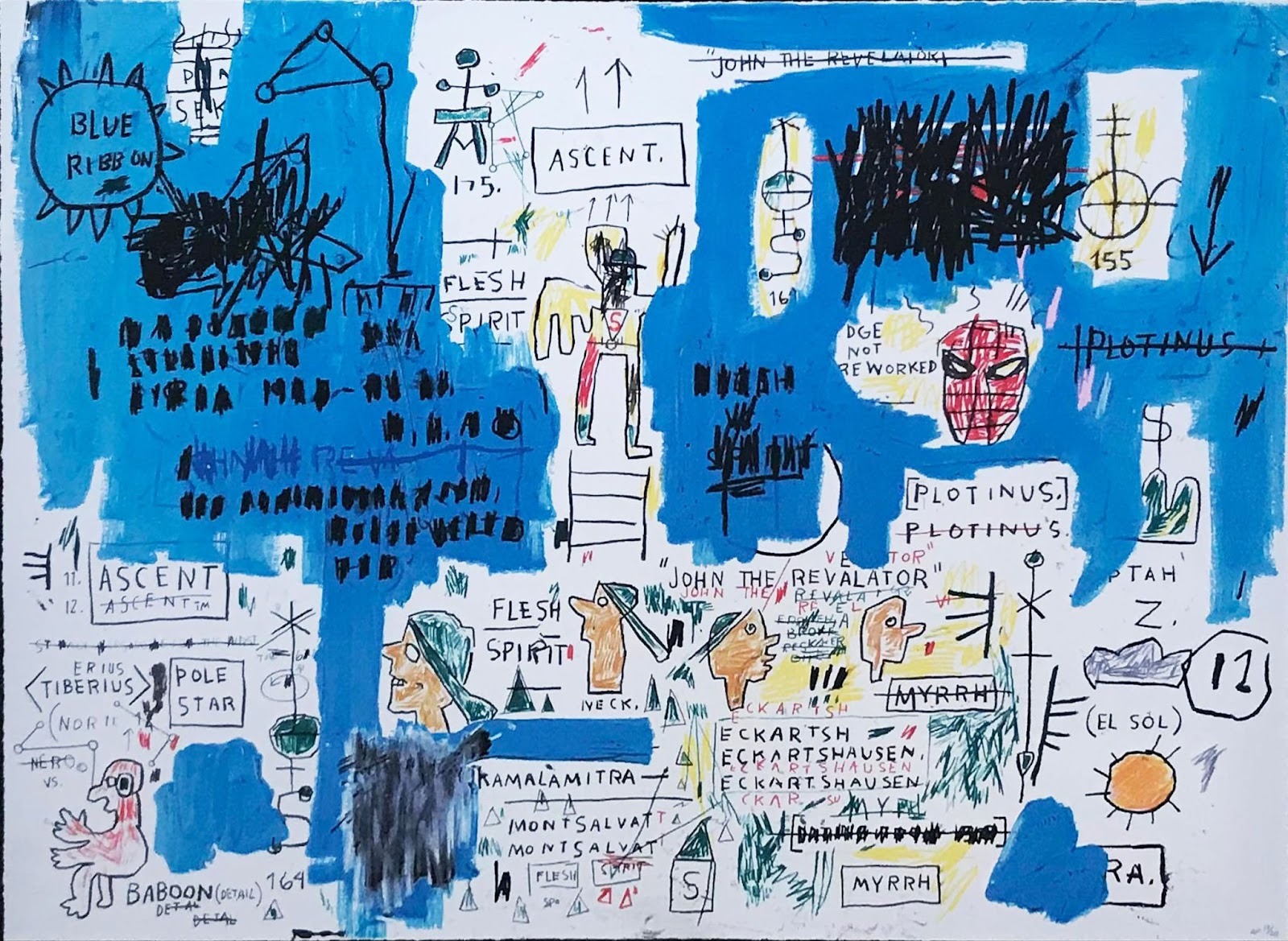
Jean-Michel Basquiat, Ascent (1982/2017)
Jean-Michel Basquiat’s public auction market has now exceeded $7.2 billion in cumulative sales, with consistently high sell-through rates across major houses. Within a market of that scale, several factors influence the price of Basquiat paintings, but they do not affect value to the same degree. Period remains the primary driver, while scale, subject matter, provenance and exhibition history each play a supporting role.
Scale plays a clear role in pricing. The highest auction results in Basquiat’s market have overwhelmingly been achieved by large, single-panel canvases from 1982 and 1983. Works such as Untitled (1982), which sold for $110.5 million at Sotheby's — a Basquiat auction record — and Dustheads (1982), which realised $48.8 million, demonstrate how expansive early canvases have set the upper benchmarks of his market.
Smaller works, particularly from the later years of his career, tend to trade at lower levels. The distinction is not simply about dimensions; it reflects which works the market has consistently valued most highly.
Subject is also important. Paintings featuring the motifs most closely associated with Basquiat, particularly the crowned figures, skull imagery and anatomical forms referenced earlier, tend to attract stronger demand than more peripheral themes. These works are immediately recognisable and frequently form the centrepieces of major collections.
Provenance also contributes meaningfully to price. Paintings that have passed through respected galleries, appeared in notable exhibitions or belonged to established private collections carry additional confidence in the marketplace. Since the Basquiat authentication committee ceased operations in 2012, documentation and proof of ownership have become even more important in underwriting value.
Even when scale, subject and provenance align, the date of execution remains critical. A strong 1986 canvas will typically trade in a different bracket to a comparable work from 1982, and that pattern has remained consistent across decades of sales. This is why the Basquiat art price conversation keeps circling back to the early 1980s.
|
Collector Insight: Basquiat by Numbers
|
Why 1982-1984 Drives the Basquiat Art Price

Jean-Michel Basquiat, Rinso (1982/2001)
The pricing differential attached to works created between 1982 and 1984 is often described as Basquiat’s peak-period premium. In practical terms, it means that paintings from these three years consistently trade at higher levels than works produced before or after.
Major canvases from 1982 to 1984 regularly achieve between $15 million and $60 million, with exceptional works exceeding that range. By contrast, paintings from 1985 to 1987 typically trade between $3 million and $12 million, depending on scale and subject. Even strong works from 1981, Basquiat’s early breakthrough year, usually sit below comparable 1982 examples.
In some cases, the difference can reach 200-500%. A museum-quality canvas from 1982 may command several times the price of a similarly scaled work from the later years of his career. This pricing structure has been visible in auction results for more than 20 years.
|
Collector Insight: How Many 1982-1984 Basquiat Paintings Exist?
|
Between November 1982 and May 1984 alone, Basquiat produced approximately 355 paintings — an extraordinary volume in less than two years. While that may sound like good news for collectors, only a portion of those works remain in private circulation. Many now sit in institutional collections or long-term holdings, limiting availability at the highest level of the market.
Over time, 1982-1984 has come to represent the high point of his practice, and the upper tier of his market has formed around it. When record prices are achieved, they overwhelmingly originate from this period.

Jean-Michel Basquiat, 50 Cent Piece (1982/2019)
Basquiat Auction Records and Market Benchmarks: A Comparative Breakdown
While standout late works can exceed expectations, the upper ceiling continues to be set by paintings from 1982 to 1984. That distinction is most evident at the top of the market.
|
1981 (Breakthrough Year)
|
1982-1984 (Peak Years) |
1985–1987 (Later Years)
|
|
|
|
This pricing pattern has been reinforced repeatedly across New York, London and Hong Kong sales.
The $110.5M Benchmark: How Auction Records Shape Basquiat Paintings Worth

Jean-Michel Basquiat, Flexible (1984/2016)
The clearest illustration of this structure remains Untitled (1982), which sold for $110.5 million at Sotheby’s in 2017, establishing a new world record for the artist. For many collectors, the Basquiat 1982 price achieved that evening marked a turning point, establishing a new reference point for his most iconic paintings.
Other major sales, including the reported $100 million private sale of Boy and Dog in a Johnnypump (1982), the $48.8 million auction of Dustheads (1982) and the $45.3 million sale of Flexible (1984), underline the continued importance of that period.
Auction records function as reference points for what follows, influencing how later works are estimated and how sellers position them. For Basquiat, it is still the paintings from the early 1980s that sit at the top of his market.
Does the Peak-Period Premium Apply to Basquiat Prints?

Jean-Michel Basquiat, Boxer Rebellion (2018)
Although this article focuses on paintings, a similar structure can be observed in Basquiat’s print market, which plays an important role in preserving and circulating the artist’s visual language. Average print sale prices have risen by more than 250% since 2006. In recent auctions, prints have achieved approximately 137% above their mid-estimates, indicating strong competition among buyers.
Since his death in 1988, the Estate of Jean-Michel Basquiat has authorised a limited number of editions, including ‘Portfolio I’, the ‘Superhero’ portfolio and individual releases such as Flexible and Hollywood Africans in Front of the Chinese Theatre. These editions predominantly reproduce works from the early 1980s, the strongest phase of his practice.
Within these editions, the most valuable prints - featuring Basquiat’s most recognisable subjects, particularly skull imagery and crowned figures, tend to attract the strongest and most consistent interest, tend to attract the strongest and most consistent interest. While limited edition prints trade at a different level from original canvases, even within the early 1980s material, certain motifs carry greater weight than others.
What This Means for Collectors Today
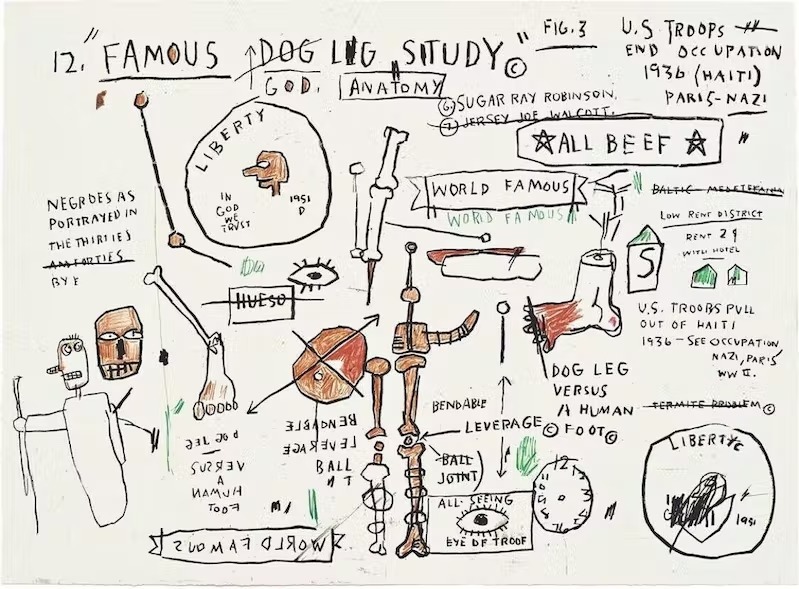
Jean-Michel Basquiat, Dog Leg Study (2019)
For collectors assessing Basquiat paintings worth today, the premium attached to his 1982-1984 works reflects decades of consistent market behaviour. Collectors pay more for these works because the market has repeatedly demonstrated that they are core to his reputation, his institutional presence and his pricing history.
That does not mean every painting from these years commands a record figure. Subject, scale and provenance still impact outcomes, but when competition is strongest, it is typically for works from this period. Over time, those works have proven the most resilient at auction and the most consistently rewarded.
Prints follow a similar, though more accessible, pattern. Editions tied to early-1980s imagery tend to attract the highest demand. While price points differ significantly from paintings, the underlying hierarchy remains visible.
Across both mediums, a clear ownership history matters. With no active authentication committee in place, collectors place considerable importance on documented provenance and exhibition records.
At Maddox Gallery, we advise clients on where a work sits within the established arc of Basquiat’s career, and on identifying paintings and prints that align with the long-term pricing patterns visible in his market.
To discuss available works by Jean-Michel Basquiat or receive a confidential valuation, speak with a Maddox Art Advisor today.
READ MORE


Previous
Next
Basket
Please note items are not reserved until you have completed checkout.
No items found
Close
Your saved list
This list allows you to enquire about a group of works.
No items found
Enter your email to subscribe to our weekly newsletter.
Speak to a Maddox Art Advisor
Please enter your details below and someone from Maddox Gallery will call or email you back.
Mikael B
Register your interest in
Mikael B
Ross Muir
Register your interest in
Ross Muir
Andy Gotts
Register your interest in
Andy Gotts
Seb Chaumeton
Register your interest in
Seb Chaumeton
Miaz Brothers
Register your interest in
Miaz Brothers
The Connor Brothers
Register your interest in
The Connor Brothers
Jerkface
Register your interest in Jerkface.

Register your interest in

London
Gstaad
Los Angeles


